
Why Small-Batch Coffee Beats Mass-Produced Every Single Time
Let's get one thing straight: that bag of coffee sitting on a grocery store shelf has been dead for weeks. Maybe months. It's a ghost of what coffee is supposed to taste like, and you've been drinking ghosts this whole time.
No wonder you needed three pumps of vanilla creamer to choke it down.
At Struggle On Coffee Co., we roast in small batches right here in Southeast Missouri — not because it's trendy, but because it's the only way coffee actually tastes like coffee. Here's why that matters.
What "Small-Batch" Actually Means
Small-batch coffee isn't a marketing buzzword. It's a fundamentally different process.
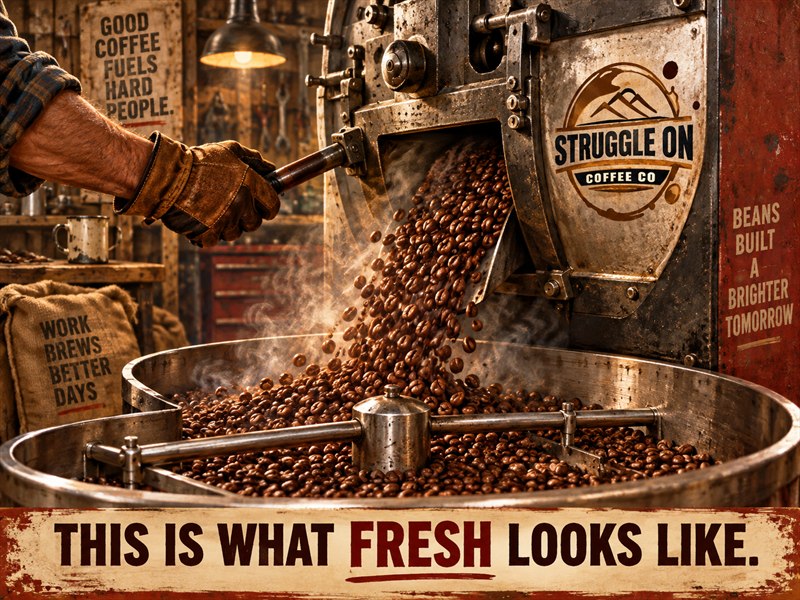
When a mega-roaster produces coffee, they're roasting thousands of pounds at a time in industrial drum roasters the size of a minivan. The beans tumble for hours, get blasted with heat, and come out evenly... mediocre. The goal isn't flavor — it's consistency at scale. Every bag tastes exactly the same: fine. Not great. Not terrible. Just... fine.
Small-batch roasting is different. We roast in small quantities — think pounds, not pallets — which means:
- Every bean gets attention. We can see, smell, and hear the roast developing. Coffee goes through distinct stages (first crack, development, second crack), and in a small roaster, we can actually respond to what the beans are doing in real time.
- Heat penetrates evenly. A smaller drum means better heat distribution. No burnt outsides and raw insides. The roast develops uniformly, which means better flavor extraction when you brew.
- We roast to order. Your coffee isn't sitting in a warehouse aging. It's roasted, bagged, and shipped. You get it at peak flavor, not after a three-month shelf life.
The Freshness Problem Nobody Talks About
Here's something the big coffee brands don't want you to know: coffee has a shelf life. And it's shorter than you think.
Coffee beans peak 3–14 days after roasting. After that, the flavors start to degrade. The oils oxidize. The aromatics — those complex, beautiful compounds that make coffee smell like chocolate, fruit, caramel, or flowers — evaporate. By the time a bag of mass-produced coffee reaches a grocery store shelf, it's been sitting there for weeks or months. It's not coffee anymore. It's brown memory.
When you buy from a small-batch roaster like Struggle On, you're getting coffee that was roasted days ago, not months. The difference isn't subtle. It's the difference between a fresh tomato from the garden and a tomato that's been in a truck for two weeks. Same vegetable. Completely different experience.
Flavor: The Obvious Difference
Mass-produced coffee tastes like... coffee. That's it. One note. Generic. The kind of flavor that disappears into creamer and sugar because there's nothing worth tasting on its own.
Small-batch coffee tastes like something. Our Big Bean Energy, roasted from Nicaraguan Parainema beans, has a smooth, bold character with a confidence that doesn't need creamer to show up. Our Toasted Campfire tastes like s'mores — actual graham cracker, chocolate, and marshmallow notes — because the roast was developed to bring those flavors out, not to survive a 12-month shelf life.
When beans are roasted in small batches with care, the natural flavor compounds survive. You taste the origin. You taste the roast profile. You taste the difference between a Nicaraguan bean and a Guatemalan bean. Mass-produced coffee flattens all of that into one generic "coffee flavor" because nuance doesn't scale.
Local Means Something
We roast in Southeast Missouri. Not in a co-packing facility in another state. Not in a warehouse that also roasts twelve other brands. Here. In our shop. By people who live here.
Why does that matter? Because local roasting means:
- Shorter supply chain. Fewer middlemen between the roaster and your cup. The coffee gets to you faster, which means it's fresher when it arrives.
- Accountability. If something's wrong with your coffee, you're not calling a 1-800 number to talk to someone in a call center. You're talking to the people who roasted it.
- Community. Every bag you buy supports a local business, local artisans (our mugs are handmade by Fox Stoneware in Jackson, MO; our leather patch hats by Grant Leather, also in Jackson), and the local economy. That's not charity — that's just how small economies work when people choose quality over convenience.
The Price Myth
Here's the thing that surprises people: small-batch coffee isn't significantly more expensive than the "premium" grocery store brands. Our coffee is $15 per bag. That's $15 for coffee that was roasted this week, by a person, in a shop you can actually find on a map.
Some grocery store "specialty" coffees cost $12–$18 and have been sitting on a shelf since the last administration. You're not paying for quality — you're paying for the label.
With small-batch, you're paying for the coffee. Not the marketing budget. Not the shelf placement. Not the CEO's third vacation home. The coffee.
How to Tell if Your Coffee Is Actually Fresh
If you want to check whether your current coffee is fresh or fossilized, try this:
- Check the roast date. If there's no roast date on the bag, that's a red flag. "Best by" dates are meaningless — they tell you when the coffee is legally still "safe," not when it tastes good.
- Smell the beans. Fresh coffee smells intense, complex, and specific. Stale coffee smells flat, dusty, or like nothing at all.
- Look for bloom. When you pour hot water over fresh grounds, they should bubble and expand — that's CO₂ releasing from the beans. No bloom = no freshness.
- Taste it black. If you can't drink it without creamer and sugar, the coffee isn't good enough. It's that simple.
The Bottom Line
Mass-produced coffee exists because it's cheap to make and cheap to ship. It's designed for shelf stability, not flavor. It's the coffee equivalent of a gas station hot dog — technically food, but you know the difference.
Small-batch coffee exists because someone decided that coffee should taste like something. That freshness matters. That the people who drink it deserve better than "fine."
At Struggle On Coffee Co., we roast in small batches because it's the right way to do it. Not the easy way. Not the cheap way. The right way. And every bag we ship is proof that the struggle is worth it.
Your mornings deserve better than a ghost. Shop our fresh-roasted small-batch coffee →
Struggle On Coffee Co. — Small-Batch Roasts, Big Missouri Flavor. Indulgence With an Attitude. Fresh roasted to order in Southeast Missouri. Free shipping on every order.