
The Ultimate Coffee Grind Guide: Whole Bean vs Ground vs K-Cups
You've picked your coffee. You've decided on a roast. You're ready to buy. And then you hit the dropdown menu: Whole Bean, Standard Grind, Coarse Grind, or K-Cups?
If you don't know what to pick, you're not alone. Most people default to whatever they've always done without realizing that the grind size — the physical size of the coffee particles — is one of the biggest factors in how your coffee tastes. Bigger than the roast. Bigger than the bean origin. Bigger than the water temperature.
The grind determines how much coffee surface area is exposed to water, which determines how fast flavor extracts, which determines whether your coffee tastes rich and balanced or thin and sour or bitter and muddy.
Here's the complete guide. No coffee snobbery. No $300 grinder recommendations. Just the information you need to pick the right grind and make better coffee.
Why Grind Size Matters
When hot water hits coffee grounds, it dissolves and extracts compounds from the coffee. This extraction process pulls out different flavor compounds at different rates:
- First: acids and salts. These extract quickly. They give coffee its brightness, fruitiness, and complexity.
- Second: sugars and lipids. These extract in the middle. They give coffee its sweetness, body, and richness.
- Last: bitter compounds. These extract slowly. They give coffee its heavy, bitter, astringent character.
The grind size controls how fast this extraction happens:
- Fine grind = more surface area = faster extraction = more of everything, faster
- Coarse grind = less surface area = slower extraction = less of everything, slower
If you over-extract (too fine, too long), you pull too many bitter compounds and the coffee tastes harsh and astringent. If you under-extract (too coarse, too short), you only get the acids and the coffee tastes thin and sour.
The goal is balance — extracting enough of the good stuff without over-extracting the bad stuff. And the grind size is the primary lever for achieving that balance.
The Grind Sizes Explained
Whole Bean
What it is: Coffee beans, intact. No grinding done.
Best for: People who own a grinder and want maximum freshness.
Why it's the best option: Coffee loses freshness rapidly after grinding. The increased surface area means oxidation happens fast — within hours, ground coffee starts losing its aromatic compounds. Whole bean coffee stays fresh for weeks. If you have a grinder (even a cheap one), grinding right before brewing is the single best thing you can do for your coffee's flavor.
The catch: You need a grinder. A blade grinder ($15–20) works but is inconsistent. A burr grinder ($40–200+) is better because it produces uniform particle sizes, which means even extraction. If you're not ready to buy a grinder, skip this option.
Standard Grind (Medium)
What it is: Coffee ground to a medium particle size — about the consistency of table salt or beach sand.
Best for: Drip coffee makers, pour-over (V60, Chemex), AeroPress (standard recipe), and most general-purpose brewing.
Why it's the safe choice: Standard grind is the most versatile grind size. It works with the most common brewing methods and produces a balanced cup. If you're not sure what you need, get standard grind. It's the "I just want good coffee without thinking about it" option.
Brewing time: 3–5 minutes for drip; 2–3 minutes for pour-over.
Coarse Grind
What it is: Coffee ground to a large particle size — about the consistency of coarse sea salt or raw sugar.
Best for: French press, cold brew, percolator.
Why it exists: Coarse grind is for immersion brewing methods where the coffee sits in water for a long time. Because the particles are large, extraction happens slowly, which prevents over-extraction during the long steep. In a French press, coarse grounds steep for 4 minutes. In cold brew, they steep for 12–24 hours. Coarse grind ensures you get full extraction without bitterness.
The catch: Don't use coarse grind in a drip machine or pour-over. The water flows through too fast and under-extracts. You'll get weak, sour coffee.
K-Cups
What it is: Pre-ground coffee sealed in individual pods, designed for Keurig and compatible single-serve brewers.
Best for: Speed, convenience, and people who drink one cup at a time.
Why people choose it: K-Cups are the ultimate convenience format. No grinder, no measuring, no cleanup. Pop in a pod, press a button, drink coffee. The trade-off is that the coffee is pre-ground (so it's not as fresh as whole bean) and the extraction is fast (which can produce a slightly thinner cup). But with quality coffee inside — which is what we put in ours — K-Cups can make a genuinely good cup.
The catch: You need a Keurig or compatible machine. And you're paying slightly more per cup than whole bean or ground. But you're paying for convenience, and sometimes convenience is worth it.
The Grind-to-Brew Cheat Sheet
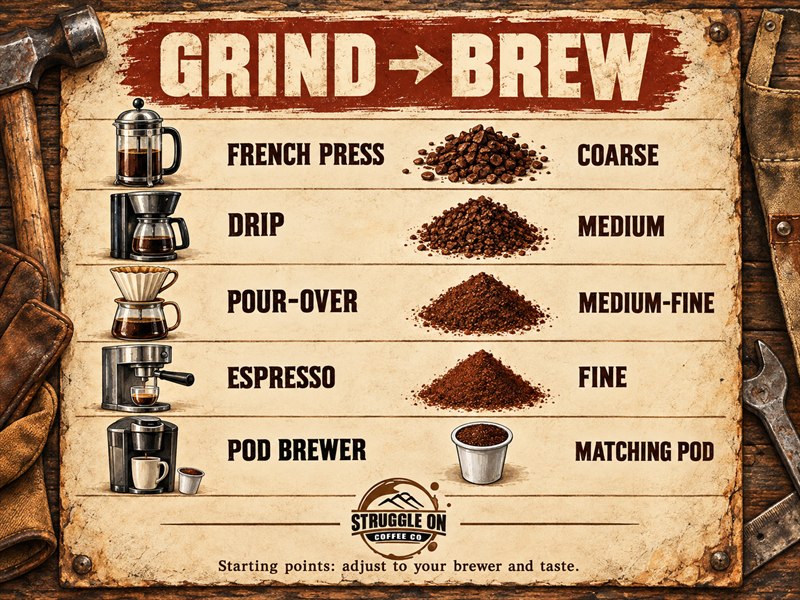
| Brewing Method | Ideal Grind | Consistency | Why | |---|---|---|---| | French Press | Coarse | Coarse sea salt | Long steep needs slow extraction | | Cold Brew | Coarse | Coarse sea salt | 12–24 hr steep; fine would over-extract | | Drip Machine | Standard (Medium) | Table salt | Balanced extraction for auto-drip | | Pour-Over (V60) | Standard (Medium) | Table salt | Controlled flow rate, even extraction | | Chemex | Medium-Fine | Sand | Thicker filter needs slightly finer | | AeroPress | Standard or Fine | Table salt to sugar | Versatile; depends on recipe | | Espresso | Fine | Powdered sugar | High pressure needs fine grind for resistance | | Moka Pot | Fine | Sand + sugar | Stovetop pressure extraction | | Keurig / K-Cups | Pre-ground (in pod) | N/A | Designed for the machine |
How We Handle Grinding at Struggle On
When you order coffee from us, you choose your grind:
- Whole Bean — we ship the beans intact. You grind at home. Best flavor, requires a grinder.
- Standard Grind — we grind to medium. Works for drip, pour-over, AeroPress. The "I don't want to think about it" option.
- Coarse Grind — we grind to coarse. For French press and cold brew people.
- K-Cups — we fill pods with the same coffee. For the one-button morning.
We grind when you order, not before. Your ground coffee ships fresh — not pre-ground and sitting in a bag for three months. That matters, because ground coffee loses flavor fast. Even our pre-ground option is fresher than anything on a grocery store shelf.
Which Should You Choose?
Choose Whole Bean if:
- You own a grinder (burr preferred, blade acceptable)
- You want the best possible flavor
- You're willing to spend 30 seconds grinding before brewing
- You drink coffee regularly and go through a bag in 1–2 weeks
Choose Standard Grind if:
- You use a drip machine or pour-over
- You don't have a grinder
- You want good coffee without extra steps
- You're buying for an office or as a gift
Choose Coarse Grind if:
- You use a French press
- You make cold brew
- You know what coarse grind is and you're here on purpose
Choose K-Cups if:
- You have a Keurig
- You drink one cup at a time
- You're short on time in the morning
- You want convenience without sacrificing quality
The Bottom Line
The grind isn't an afterthought — it's a decision that affects every cup you brew. Match the grind to your brewing method and you'll get better coffee instantly. No new equipment required. No barista course needed. Just the right grind for the right brew.
And if you're not sure? Get standard grind. It'll work. We'll be here when you're ready to level up.
Pick your grind. Shop coffee →
Struggle On Coffee Co. — Small-Batch Roasts, Big Missouri Flavor. Indulgence With an Attitude. Fresh roasted to order in Southeast Missouri. Free shipping on every order.