
K-Cups That Don't Suck: How We Made Convenience Taste Good
Let's address the elephant in the kitchen: K-Cups have a reputation problem.
They're the fast food of coffee. The convenience store hot dog. The "I don't have time for this" button that delivers a cup of something that is technically coffee but tastes more like the idea of coffee — a vague, watery approximation that exists solely to deliver caffeine without joy.
We get it. We've had those K-Cups. We've stood in the kitchen at 6:47 a.m., pressed a button, and watched brown liquid dribble into a mug while questioning our life choices. We know what bad K-Cups taste like.
That's why we made our own. And that's why ours don't suck.
The Problem with Most K-Cups
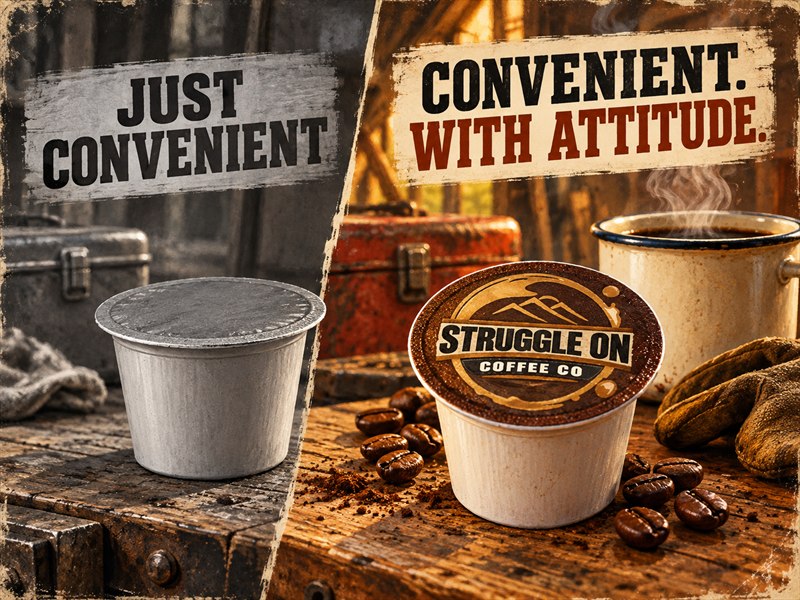
To understand why most K-Cups taste bad, you have to understand what's actually inside them.
1. Low-grade coffee. The coffee going into most K-Cups is the cheapest available — often robusta beans (which are harsher and more bitter than arabica), or the lowest-grade arabica that didn't make the cut for bagged retail. When you start with bad coffee, no amount of packaging technology can fix it.
2. Stale before packaging. K-Cups are filled and sealed in massive facilities. The coffee is roasted, ground, and packed — but not necessarily in that order, and not necessarily quickly. By the time the K-Cup is sealed, the coffee inside may already be weeks past its peak.
3. Pre-ground staleness. Coffee loses freshness much faster once it's ground. The increased surface area means oxidation happens rapidly. K-Cups contain pre-ground coffee that's been sitting in a plastic cup, sometimes for months.
4. Weak extraction. Keurig machines push water through the K-Cup quickly — often too quickly for proper extraction. The result is a cup that's under-extracted: thin, sour, and lacking body. Even good coffee would taste mediocre through a bad extraction.
5. Plastic flavor. Hot water + cheap plastic = a subtle but noticeable plastic taste that contaminates the coffee. Some K-Cups are better than others, but the problem is real.
So: bad coffee, stale before packaging, pre-ground, poorly extracted, and served through plastic. And people wonder why K-Cups get a bad rap.
How We Did It Differently
When we decided to offer K-Cups, we had one rule: they have to taste like our coffee. Not "close to our coffee." Not "an approximation of our coffee." Like our coffee. Same beans, same roast profiles, same flavor — just in a convenient format.
Here's how we made that happen:
Same Beans, Same Roasts
Our K-Cups are filled with the exact same coffee we sell in bags. Big Bean Energy K-Cups contain the same Nicaraguan Parainema beans, roasted the same way. Toasted Campfire K-Cups have the same flavored coffee we bag by hand. No downgrade. No "K-Cup blend." No switching to cheaper beans for the pod line.
If you buy our Big Bean Energy in a bag and in K-Cups, you're getting the same coffee. Period.
Small-Batch Roasting, Even for K-Cups
We don't outsource our K-Cup production to a co-packer who roasts 5,000 pounds at a time. We roast in small batches — the same way we roast everything — and fill K-Cups from those batches. The coffee going into our K-Cups is fresh-roasted, not pulled from a warehouse of pre-made pods.
Quality Packaging
We use K-Cups designed to minimize the staleness problem. The pods are sealed to protect against oxygen and moisture, and they're filled from fresh roasts, not from coffee that's been sitting around. The packaging is designed to preserve flavor, not just to survive a shipping container.
Honest Pricing
Our K-Cups are $15 for a 12-count box. That's $1.25 per cup. Compare that to:
- Grocery store K-Cups: $8–12 for 12–18 cups ($0.44–$0.67 per cup) — but you're drinking stale, low-grade coffee
- Premium K-Cup brands: $12–18 for 10–12 cups ($1.20–$1.80 per cup) — closer in price, but still mass-produced
- A coffee shop: $3–6 per cup — and you have to drive there
$1.25 per cup for fresh-roasted, small-batch coffee that you make by pressing one button? That's not a bad deal. That's a genuinely good one.
Who Are K-Cups For?
Let's be honest: K-Cups aren't for the person who has 20 minutes to do a pour-over with a gooseneck kettle and a scale. That person is already buying our whole bean coffee and loving life.
K-Cups are for:
- The parent who's been up since 4:30 a.m. and has approximately 45 seconds to make coffee before the toddler discovers the cat food
- The commuter who's already late and needs coffee in a travel mug NOW, not in 8 minutes
- The office worker whose breakroom has a Keurig and no other option
- The person who just wants one cup and doesn't want to clean a French press
- The person pretending to be a functional adult who can't handle a multi-step morning process
K-Cups are about convenience. And there's nothing wrong with convenience — as long as the coffee inside is actually good. The problem was never the format. The problem was that companies filled the format with garbage and called it coffee.
We filled it with our coffee instead. Problem solved.
The Flavor Lineup
Every Struggle On roast is available in K-Cups. That means you can get:
- Big Bean Energy — bold Nicaraguan Parainema, medium roast, smooth and confident
- Brewed Awakening — the "legal stimulant disguised as a hot beverage" for people who laugh at sleep
- Salted Caramel — smooth, buttery, sweet with a touch of salt
- Toasted Campfire — s'mores in a cup, no bugs required
- Chocolate Pecan Pie — dessert for breakfast, no judgment
- Raspberry Jelly Donut — because sometimes morning should taste like a bakery
- Black & Tan — for the traditionalist who wants it strong and simple
- Deep & Dirty Roast — dark, bold, unapologetic
- Chocolate Raspberry — decadent chocolate meets punchy raspberry
- Midas Touch — for when your coffee needs to feel like luxury
All $15 per 12-count box. All the same coffee we sell in bags. All roasted in small batches and shipped fresh.
The Bottom Line
K-Cups got a bad reputation because they deserved it. Most of them are filled with stale, low-grade coffee and taste like hot water with ambitions.
But the format isn't the problem. The coffee inside is the problem. And that's fixable.
We fixed it. Same beans. Same roasts. Same small-batch quality. One button. Zero excuses.
Whether you're running late, wrangling kids, or just pretending to be a functional adult — we've got you covered. 12 chances to turn chaos into "okay, I got this."
Because mornings are hard. Coffee shouldn't be.
Fuel the struggle. Shop K-Cups →
Struggle On Coffee Co. — Small-Batch Roasts, Big Missouri Flavor. Indulgence With an Attitude. Fresh roasted to order in Southeast Missouri. Free shipping on every order.