
Fresh Roasted to Order: Why Coffee Freshness Matters More Than You Think
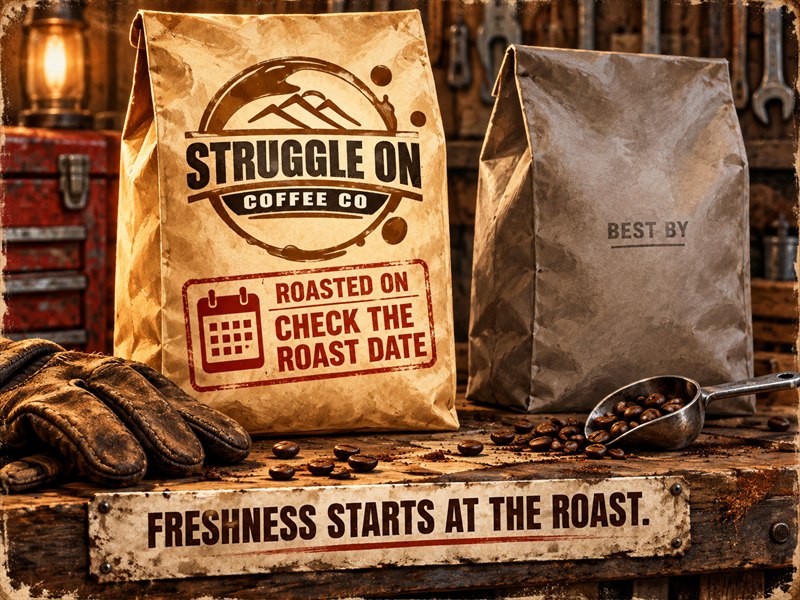
Here's a fun experiment: go to your kitchen, pick up whatever bag of coffee you currently have, and look for a roast date. Not a "best by" date. Not an expiration date. A roast date — the actual day someone roasted those beans.
Can't find one? That's because most coffee companies don't want you to know.
At Struggle On Coffee Co., we roast to order. That means your coffee doesn't exist until you order it. It's not sitting in a warehouse. It's not aging on a shelf. It's roasted, bagged, and shipped — and it arrives at your door while it's still actually fresh.
Here's why that matters more than you think.
The Science of Stale Coffee
Coffee is a perishable product. This isn't opinion — it's chemistry. Once coffee beans are roasted, a clock starts ticking. Here's what happens:
Days 1–3 after roasting: The beans are still degassing — releasing CO₂ built up during the roasting process. Brewing during this window can cause uneven extraction because the gas disrupts water contact with the grounds. Some coffees benefit from a brief rest; others are great immediately.
Days 3–14 after roasting: Peak flavor window. The beans have degassed enough for even brewing, and the aromatic compounds — the stuff that makes coffee smell and taste like chocolate, fruit, caramel, nuts, or flowers — are at their strongest. This is the sweet spot. This is when coffee is actually coffee.
Days 14–30 after roasting: Flavor decline begins. The aromatics start to fade. The oils begin to oxidize. The cup loses brightness, complexity, and character. It's not undrinkable — it's just... less. Like a photograph that's been in the sun too long.
30+ days after roasting: The coffee is stale. The aromatics are mostly gone. The oils have oxidized. What remains is a flat, generic "coffee flavor" that needs creamer and sugar to be palatable. This is what most people are drinking. This is what most people think coffee tastes like.
6+ months after roasting: The coffee is technically dead. The oils have gone rancid. The flavor is a hollow shell. But it's still being sold on grocery store shelves, because "best by" dates are set 6–12 months out — not for flavor, but for food safety. The coffee won't make you sick. It just won't taste like anything worth drinking.
What "Roasted to Order" Actually Means
"Roasted to order" is exactly what it sounds like: we don't roast until you order.
Here's how it works at Struggle On:
- You place an order. Big Bean Energy, Toasted Campfire, Salted Caramel — whatever you want.
- We roast it. Small batch, monitored, adjusted to the bean. Not pulled from a pre-roasted inventory.
- We bag it and ship it. Free shipping on every order. The coffee arrives at your door within days of roasting — well within the peak flavor window.
- You drink coffee that tastes like something. Novel concept.
The alternative — the way most coffee companies operate — is:
- Roast 10,000 pounds of coffee.
- Bag it.
- Put it in a warehouse.
- Ship it to stores.
- It sits on a shelf.
- You buy it three months later.
- You drink stale coffee and wonder why you need creamer to make it taste like anything.
Why Most Coffee Companies Don't Roast to Order
It's not because they don't know freshness matters. It's because roasting to order is expensive and logistically harder.
When you roast to order, you can't stockpile. You can't optimize for warehouse efficiency. You can't predict exactly how much you'll need on any given day, which means you might roast too much (waste) or too little (stockouts). You need more flexibility, more attention, and more labor per pound.
Mass-produced coffee is designed for the supply chain, not the customer. The goal is to produce a product that sits on a shelf for months without anyone noticing it's gone stale. And the trick is: most people don't notice, because most people have never had fresh coffee. They don't know what they're missing.
Once you've had fresh-roasted coffee — once you've tasted a cup that was roasted five days ago instead of five months ago — you can't un-taste the difference. Stale coffee doesn't taste bad in an obvious way. It tastes empty. Like something was there and left.
How to Keep Your Coffee Fresh
Once you get fresh coffee, keeping it fresh is on you. Here's how:
- Store it properly. Keep beans in an airtight container at room temperature. Not in the fridge (moisture is the enemy). Not in the freezer (temperature fluctuations cause condensation). A sealed bag or container in a cabinet is perfect.
- Buy in amounts you'll use within 2–3 weeks. Buying a year's supply of coffee to "save money" means you're drinking stale coffee for 11 months. Buy what you'll drink. Reorder when you're running low. That's the whole point of roasted-to-order.
- Grind right before brewing. Whole bean coffee stays fresh longer than pre-ground. Once you grind coffee, the surface area increases exponentially, and oxidation accelerates. Grinding right before brewing preserves the maximum amount of flavor. If you don't have a grinder, we offer ground coffee — but if you can swing a $20 burr grinder, it's worth it.
- Keep it away from light, heat, and air. UV light, heat, and oxygen are the three horsemen of coffee degradation. A cool, dark cabinet in an airtight container is all you need.
The "Best By" Date Lie
Here's something that should make you angry: "best by" dates on coffee are meaningless for flavor purposes.
A "best by" date tells you when the coffee is no longer considered safe to consume from a food safety standpoint. It has nothing — nothing — to do with when the coffee tastes good. A bag of coffee with a "best by" date 12 months out could have been roasted 11 months ago. It's "safe." It's also dead.
The only date that matters on a bag of coffee is the roast date. If there's no roast date, the company is either embarrassed by it or doesn't want you to know how old the coffee is. Either way, it's a red flag.
At Struggle On, we roast to order. Your coffee is days old when it arrives, not months. That's not a feature. That's the baseline.
The Bottom Line
Coffee freshness isn't a luxury. It's not a "coffee snob" thing. It's the difference between food that tastes like food and food that tastes like the memory of food.
If you've never had fresh-roasted coffee, you're operating with a false baseline. You think coffee is supposed to taste the way it does in your cup. It's not. It's supposed to taste better. Much better. And the only thing standing between you and better coffee is freshness.
We roast to order because it's the right way to do it. Not the easy way. Not the profitable-at-scale way. The right way.
Stop drinking ghosts. Shop fresh-roasted coffee →
Struggle On Coffee Co. — Small-Batch Roasts, Big Missouri Flavor. Indulgence With an Attitude. Fresh roasted to order in Southeast Missouri. Free shipping on every order.